

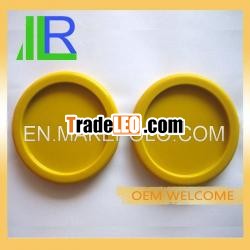
Description:
silicone pads1: ISO 9001, 14001, FDA
2: Daily use, no toxic
3.High or low temperature resistance, ozone resistance
Moldedsilicone pads
1. Main material | Silicone rubber, also can use Natural rubber,Styrene-butadiene rubber, Nitrile rubber, PU, EPDM, Neoprene, ButylRubber, Fluorocarbon, Chlorohydrine rubber and Methacrylate rubber,etc. |
2. Certification | ISO 9001, 14001, Rosh |
3. Density | 1.1~1.3g/cm3 |
4. Hardness | 15~95 shore A |
5. Ultimate tensile | 10~30MPA |
6. Ultimate elongation | 200%~900% |
7. Tolerance | 0.1mm~0.3mm |
8. Available place: | Using them can prolong machine life, reduce maintenance costs,also can reduce shutdowns, downtime and rejects. Furthermore, theyexcellent resistance to aging, compression set oil and water. Special places such as industry, catering, medical industry asseal, damper, insulation products. They also used in aviation,missiles, rockets and other top technology industry. |
9. Main performance | Good electrical insulation No toxic Typically the range is -60C to 200C and above Good Ozone resistance |
10. MOQ | 1000pcs, but low quantity order are acceptable |
11. Color and shape | can be changed upon request. In various sizes and colors areavailable. |
12. Price terms | FOB, CIF, CFR, etc |
13. Export area | Japan, France, Canada, etc |
14. Packaging details | Inner packing is plastic bag and outer packing is exportstandard carton box |
15. Price items | T/T, L/C, Western union, Cash |
16. Port | Dalian Port |
17. OEM | Accept |
More siliconeproducts
http://www.shanrong-rubber.cn/productgrouplist-200160344/Silicone_products.html#products
about Silicone rubber
Silicone rubber is generally non-reactive, stable, and resistantto extreme environments and temperatures from −55 °C to 300°C while still maintaining its useful properties. Due to theseproperties and its ease of manufacturing and shaping, siliconerubber can be found in a wide variety of products, including:automotive applications; cooking, baking, and food storageproducts; apparel such as electronics; medical devices ; and inhome repair and hardware with products.
Silicone rubber offers good resistance to extreme temperatures,being able to operate normally from −55 °C to 300 °C. At theextreme temperatures, the tensile strength, elongation, tearstrength and compression set can be far superior to conventionalrubbers although still low relative to other materials. Organicrubber has a carbon to carbon backbone which can leave themsusceptible to ozone, UV, heat and other ageing factors thatsilicone rubber can withstand well. This makes it one of theelastomers of choice in many extreme environments.
Compared to organic rubbers, however, silicone rubber has a verylow tensile strength.[1] For this reason, care is needed indesigning products to withstand even low imposed loads. Thematerial is also very sensitive to fatigue from cyclic loading.Silicone rubber is a highly inert material and does not react withmost chemicals. Due to its inertness, it is used in many medicalapplications and in medical implants
Becoming more and more common at the consumer level, siliconerubber products can be found in every room of a typical home. Fromautomotive applications; to a large variety of cooking, baking, andfood storage products; to apparel, undergarments, sportswear, andfootwear; to electronics; to home repair and hardware, and a hostof unseen applications.

