

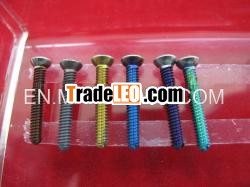
Description:
High QualitySend it fast
Specifications
316LVM material has been used for permanent implants for manyyears. The corrosion resistance in the annealed condition isgood.
Melt Practice
This austenitic stainless steel is initially electric-arc melted.Then as a refinement to the purity and homogeneity of the metal,360LVM is Vacuum Arc Remelted (VAR). This process yields a moreuniform chemistry with minimal voids and contaminants. This alloymeets the requirements of 316LS.
Typical Chemistry
| THM Avg. Wt. % | ASTM F138 |
Carbon | 0.023 | 0.017 |
Manganese | 1.84 | 1.72 |
Silicon | 0.37 | 0.43 |
Phosphorus | 0.014 | 0.016 |
Sulphur | 0.001 | 0.001 |
Chromium | 17.57 | 17.45 |
Nickel | 14.68 | 14.52 |
Molybdenum | 2.79 | 2.66 |
Copper | 0.03 | .08 |
Nitrogen | 0.03 | 0.3 |
Iron | Balance | Balance |
THM chemistry is for reference only, and is not to be used forspecification purposes.
Physical Properties
Density | 0.287 lbs/in3 |
Modulus Of Elasticity | 27.9 psi x 106 |
Electrical Resistivity | 740 µohms-mm |
Thermal Conductivity | 16.3 W/mK(100.25°C) |
Thermal Treatment
A reducing atmosphere is preferred for thermal treatment, but inertgas can be used. 316LVM will fully anneal at 1010-1121.25°C in justa few minutes. The precipitation of carbides that decreasescorrosion resistance in other 300 series alloys is controlled byreduced carbon content in 316LVM.
Applications
316LVM material has been used for permanent implants for manyyears. The corrosion resistance in the annealed condition is good.Many studies for new alloys use 316LVM as a reference. Thisstainless steel has good ductility in the cold worked condition.Applications include: suture wire, orthopaedic cables, skin closurestaples, catheters, stylets, bone pins and many small machinedparts.
Mechanical Properties
%CW | Y.S.(psi) | U.T.S.(psi) | % Elongation (10" gaugelength) |
0% | 45, 000 | 91, 000 | 42% |
20% | 110, 000 | 123, 000 | 8% |
37% | 145, 000 | 160, 000 | 2.5% |
50% | 161, 000 | 176, 000 | 2.2% |
60% | 170, 000 | 191, 000 | 2.1% |
68% | 176, 000 | 203, 000 | 2.5% |
75% | 191, 000 | 218, 000 | 2.6% |
80% | 186, 000 | 217, 000 | 2.6% |
84% | 202, 000 | 227, 000 | 2.6% |
90% | 205, 000 | 238, 000 | 2.6% |
93% | 212, 000 | 239, 000 | 2.6% |
95% | 213, 000 | 246, 000 | 2.8% |
Values are typical and may not represent all diameters. Test methodwill affect results.
Surface Condition
Stainless steels develop a highly polished appearance as they aredrawn to fine diameters. Surface roughness can be less than 5 RMSwhen processed using SCND* dies and measured with a profilometer.Diameters over 0.040" are finished with polycrystalline dies andexhibit a rougher surface than natural diamond dies. Diameters over0.100" will have an even rougher surface because they are drawnwith carbide dies. Additional finish treatments can enhance thesurface of the wire.

