

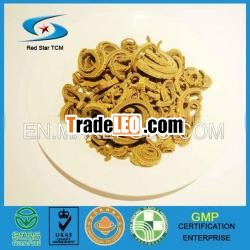
Description:
1.Fast delivery2.GMP
3.Big quantity and high quality with competetive price
4.Dampness and dissolving phlegm
| Productname | Ginger Magnolia Officinalis; Cortex Magnoliae Officinalis |
| Type | Dampness-transformingmedicinal |
| Taste | Warm; Bitter; to spleen,lung, stomach, large intestine |
Constituent | Volatile oil; Magnolol;Tetrahydro Magnolol; Isobutyl Magnolol;Magnocurarine |
| Indications | 1.Eliminating dampness andresolvingphlegm 2.Resolving Food Stagnancy 3.Humidity hysteresis 4. Abdominal swelling of vomiting and diarrhea 5.Dyspepsia 6.Abdominal distension and constipation 7. Phlegm andcough |
| Function | 1.Appetiser 2.Digestive3.Diuretic 4.Emmenagogue 5.Expectorant6.Stomachic |
Pharmacologicaction | 1.Anti-allergic2.Anti-asthmatic 3.Anti-bacterial 4.Anti-fungal 5.Anti-septic 6.Anti-spasmodic 7.Anti-stress 8.Anxiolytic |
| Application | 1.Gastroenteric tumor withcool in spleen and stomach, turbid phlegm 2. Abdominalneoplasms |
| Contraindication | 1.The pregnant shall beprecautions for application 2.Qi deficiency and bodyfluid deficiency forbide |
| Productivity | 300tons/year |
Cortex Magnoliae Officinalis
Magnolia bark(Magnolia officinalis) is a traditional Chinese medicine used since100 A.D. to support the body and nurture wellbeing and to treat aplethora of ailments.
Magnolia barkhas been used to treat menstrual cramps, abdominal pain, abdominalbloating and gas, nausea, and indigestion. The bark is also aningredient in formulas used for treating coughs and asthma. Thebark is used internally in the treatment of abdominal distension,loss of appetite, gastro-enteritis, vomiting, diarrhoea, asthma andcoughs with acute phlegm. The bark and flower buds of Magnoliaofficinalis have been used to treat coughs and colds and intestinalproblems.
Japanese researchershave determined that "honokiol" and "magnolol", two chemicals foundin Magnolia Bark, are up to 1000 times more potent than Vitamin Ein antioxidant activity. These two active compounds are thought tocontribute to the primary anti-stress and cortisol-balancingeffects of the plant. Numerous animal studies have demonstratedhonokiol to act as an anti-stress agent at lower doses. Magnolol, acompound isolated from the cortex of Magnolia officinalis, has beenfound to possess anti-allergic and anti-asthmaticactivity.

