

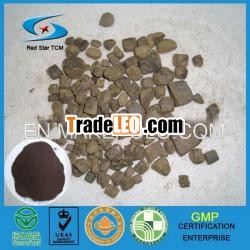
Description:
1. Calcining2. Promoting circulation and removing stasis
3. Internal and external medicine
4. Free sample
| English Name | Pyrite | Latin Name | Pyritum |
| Chinese Name | Zi Ran Tong | ||
| Processing | 1. Cleaning 2. Drying 3. Calcining 4. Processing With Vinegar 5. Packing | ||
| Function | 1. Eliminatingstasis to activate blood circulation 2. Healing the fracture 3. To relieve pain | ||
| Dosage | For oral administration:3-9g External application: Proper quantity | ||
| Cautions | Pyrite should not be administered to patients diagnosed with yindeficiency with heat, or patients who have been diagnosed withblood deficiency. As of this writing, there are no known druginteractions associated with pyrite. As always, make sure toconsult with a licensed health care provider before taking pyriteor any other herbal remedy or dietary supplement. | ||
What is pyrite? What is it used for?
Although pyrite is not an herb, it is nevertheless an importantcomponent of herbal medicine. It is actually a type of mineral,composed primarily of iron and sulfur, with traces of nickel,arsenic, copper, and antimony occasionally present.
It typically forms in the shape of a cube, with ayellowish-bronze color and a metallic luster, giving pyrite thenickname of "fool''s gold" for its resemblance to real gold. It isusually mined, washed and cleaned of impurities, then ground downinto a powder for use.
According to the principles of traditional Chinese medicine,pyrite is acrid and mild, and is associated with the Kidney andLiver meridians. The main functions of pyrite are to disperse heatand control pain. Among the conditions that pyrite can help treatare fractures, trauma accompanied by swelling and bruising, skinwounds, and general pain. Calcined pyrite is believed to be moreeffective in reducing swelling and relieving pain that non-calcinedpyrite
[ Raw MaterialOf Pyrite ]
[ Cleaning Room ]
[ Drying Room]
[ Calcining Room]
[ Finished Product]

