

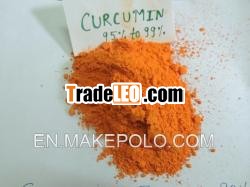
Description:
Description : Yellowish Orange Fine PowderPlant part used : Rhizomes
Atural Wffective
Curcuma Longa is a small perennial herb native to India bearingmany rhizomes on its root system which are the source of itsculinary spice known as Turmeric and its medicinal extract calledCurcumin. Curcumin is the main biologically active phytochemical compoundof Turmeric. Curcumin is extracted and researched for its renownedrange of health-related and disease-preventing medicinalproperties. Molecular chemical formula of Curcumin: C21H20O6. Curcumin extract is a technically advanced herbal extractstandardized to 95% curcuminoids. This is the highest concentrationof curcuminoids available. | |
The plant''s healing properties reside in its fingerlike stalk,which is scalded and then dried for medicinal preparations. This isthe same part of the plant used to flavor, color, and preservefoods.
Health Benefits
Among other findings, researchers discovered that turmeric(especially the curcumin component) has rich stores ofantioxidants. In the body these important disease-fightingsubstances mop up unstable oxygen molecules called free radicalsthat can otherwise damage cells and cause diseases such ascancer.
Test-tube studies done in the 1990s indicate that curcumin is aspowerful an antioxidant as vitamins C and E, and evenbeta-carotene. Antioxidants are also powerful preservatives, whichhelps explain why turmeric has long been sprinkled on food to helpretain its freshness.
In animal studies and in one human trial published in 1992,turmeric also showed promise in lowering cholesterol levels andfighting atherosclerosis, a buildup of fatty deposits in thearteries that can lead to heart attack. Preliminary studies in miceindicate that the curcumin in turmeric may even block theprogression of multiple sclerosis (MS).
The interest in the plant''s potential for preventing neurologicdiseases, such as MS and even Alzheimer''s, was spurred by therealization that elderly Indian populations that consumeconsiderable amounts of turmeric in their diet are far less likelythan their Western counterparts to develop such ailments.Scientists conjecture that turmeric benefits such neurologicillnesses by minimizing inflammation, a theory supported by recentfindings that people (Westerners in this case) takinganti-inflammatories regularly for arthritis are less likely todevelop Alzheimer''s disease. More research in this area is clearlyneeded before any specific recommendations can be made.
Today, turmeric is widely recommended for myriad ailments, fromstomach ulcers and skin infections to eye conditions (such aschronic anterior uveitis). The evidence for it actually working forany of these conditions is mixed. For example, there''s no evidencethat turmeric will help heal stomach ulcers but, when it''s appliedas a paste, it may well eliminate scabies, an itchy skin conditioncaused by parasitic mites.
Specifically, turmeric may help to:
Relieve carpal tunnel syndrome, arthritis, and jointinflammation. The anti-inflammatory compounds in turmeric appear toease inflammation. This makes it potentially useful for relievingthe inflammation in wrist and hand joints associated with carpaltunnel syndrome, for example. In India, curcumin is considered astandard anti-inflammatory medication. It appears to be mosteffective for acute (as opposed to chronic) inflammation.
Many sources recommend curcumin for arthritis-relatedinflammation and pain, but the evidence showing its effectivenessfor arthritis is unclear. In a 1980 study published in India,rheumatoid arthritis patients who took 1, 200 mg of curcumin a dayexperienced the same reduction in stiffness and joint swelling asthose who took the prescription anti-inflammatory drugphenylbutazone, which can have unpleasant side effects.Unfortunately, the study was flawed because results weren''tcompared to a placebo (dummy pill) group.
Ease indigestion, excess gas (flatulence), bloating, and othermild stomach upset. Reinforcing an ancient use for turmeric, Germanhealth authorities have declared turmeric tea a valuable remedy forstomach upset. Laboratory findings back this up: The curcumin inturmeric fights bacteria commonly responsible for infectiousdiarrhea.
Clinical trials have been somewhat promising for thistime-tested use as well. In a widely cited 1989 study, Thairesearchers found that 500 mg capsules of curcumin (taken fourtimes daily) were far more effective than a placebo in relievingindigestion. The study involved more than 116 adults at six Thaihospitals. And it was double-blind, meaning that neither theparticipants nor the researchers were aware of what eachparticipant was taking during the trial. Nearly 90% of theparticipants taking the turmeric experienced full or partial painrelief after seven days, while only 53% of the group taking theplacebo felt better.

