

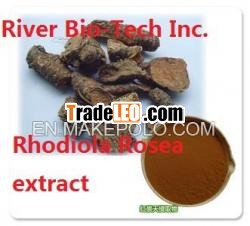
Brand:RIVER
MOQ:1 Kilogram
Quantity:1000 Kilogram
Delivery date:Since payment date 1 Days delivery
Send Inquiry
Product Details:
Type:Herbal Extract
Variety:Other
Form:Powder
Part:Leaf
Extraction Type:Solvent Extraction
Packaging:Drum,Vacuum Packed
Grade:food grade
Specifications:
- Product Name:Rhodiola Rosea extract Effectiveness: Circulationsupport / Body Balance / Immunity enhancer Content Specifications:1.0%, 2.0%, 3.0% Salidroside by HPLC 1.0%, 2.0%, 3.0% Rosavin byHPLC 3.0%, 5.0%, 7.0% Total Rosavins by HPLC
Description:
Product Name:Rhodiola Rosea extractEffectiveness: Circulation support / Body Balance / Immunityenhancer
1. Sources and Habitat
Rhodiola rosea (Rose root) is a plant in the family Crassulaceaethat grows in cold regions of the world. These include much of theArctic, the mountains of Central Asia, the Rocky Mountains, andmountainous parts of Europe, such as the Alps, Pyrenees, CarpathianMountains, British Isles, Scandinavia and Iceland.
2. Descriptions and Specifications of Product
Content Specifications: 1.0%, 2.0%, 3.0% Salidroside byHPLC
1.0%, 2.0%, 3.0% Rosavin by HPLC
3.0%, 5.0%, 7.0% Total Rosavins by HPLC
2.1 Salidroside
Molecular Formula: C14H20O7
Molecular Mass: 300.304
CAS NO: 10338-51-9
2.2 Rosavin
Molecular Formula: C20H28O10
Molecular Mass: 428.44
CAS NO: 84954-92-7
4. Indications and Uses
Rose root has been used in traditional European medicine for overthree thousand years, mainly as a tonic. Modern research has shownthat it increases the body's resistance to any type of stress byregulating the body's hormonal response. Its use has been shown tohave a protective effect upon the neurotransmitters such asserotonin and dopamine in the brain. It improves neurotransmitteractivity by inhibiting their enzymatic destruction and preventingtheir decline caused by excessive stress hormone release. Rose rootalso enhances the transport of serotonin's precursors into thebrain and studies have shown that use of this herb can increasebrain serotonin by up to 30%. The root is adaptogen. It has anenhancing effect upon physical endurance and sexual potency. Adecoction of the flowers has been used to treat stomach aches andintestinal discomfort. The raw flowers have been eaten in thetreatment of tuberculosis.
5. Safety Concerns
Rhodiola has been the subject of many clinical studies. No sideeffects or interactions have been reported. Animal studies indicatethat rhodiola has a low level of toxicity. Don't take rhodioladuring pregnancy or while breast-feeding. There is no informationavailable about the safety of rhodiola in pregnancy or lactation.Insomnia may be a risk with high doses of rhodiola. A high dose isconsidered to be daily intakes of 1, 500 to 2, 000 mg and above ofa Rhodiola rosea standardized extract.
There are no well-known drugs or nutrient interactions associatedwith Rhodiola rosea. However, much remains to be learned about thisherb and how it may interact with other adaptogens, such asSiberian ginseng, as well as with other dietarysupplements.
6. Dosage Information
Rhodiola rosea supplements can enhance your overall sense ofvitality and strength. The recommended daily dose of Rhodiola roseaextract is approximately 300 milligrams, standardized to at least1% salidroside, and 2-3% rosavins. You should notice improvedmental and physical effects after ten days.

