

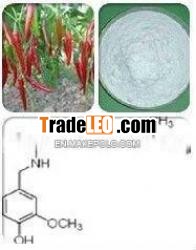
Description:
Capsaicinoids1:Manufacturer direct selling
2:High quality to Guratee
3:High bio-technology to gurantee
4:Cooperation wit
Capsaicinoids
Specification:
color:red brown or clear liquid
PH: 4.5 ~ 6.5
total solid content: =3%
total bacterial: =100pieces/m
pathogen: can’t be tested
mercury: =0.5mg/kg
arsenic: =0.5mg/k
lead: =1mg/kg
Plant Origin:Nongenetically modified organism, gluten free and wheat free, BSE/TSE free,
not tested on animals
Packaging :2.5 kg/20kg/100kg/200kg net polyethylene drums,
Storage Conditions:Store in a cool place. Protect from freezing, highlight and hot.
Retest Date:One year from manufacturing date
Functions:
1.Apsaicin is a natural compound with pharmacological and toxicological effects, which given its
hydrophobicity, can influence the structure of membranes. The interaction of capsaicin with
model membranes of dipalmitoylphosphatidylcholine and dielaidoylphosphatidylethanolamine
has been studied by using differential scanning calorimetry, fluorescent probe spectroscopy
and 31P-nuclear magnetic resonance.
2.Capsaicin remarkably affects the phase transition of dipalmitoylphosphatidylcholine
, shifting the transition temperature to lower values, and giving rise, at relatively high
capsaicin concentrations, to the appearance of two peaks in the thermogram. These
peaks may correspond to separated phases as indicated by the partial phase diagram.
Whereas capsaicin did not affect the fluorescence polarization of the probes diphenylhexatriene
and trimethylammonium-diphenylhexatriene,it clearly affected that of the probe 2-anthroyloxystearic acid, indicating that the perturbation produced by capsaicin on the
membrane would be mainly at the position where this fluorophore is located.
3.On the other hand, capsaicin, at relatively low concentrations, gives rise to immiscible
phases in the presence of dielaidoylphosphatidylethanolamine and decrease the temperature
of the lamellar to hexagonal HII phase transition.
4.At concentrations of capsaicin higher than 0.3 mol fraction, isotropic phases were detected.
The possible implications of the effects of capsaicin on biological membranes are discussed.

