

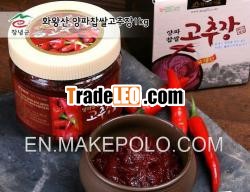
Description:
The Korean Red Peppers Paste have an abundance of capsaicin and arethe best for providing amino acids or natural sugarsKorean Red PepperPaste
This is the traditional redpepper paste left to ferment for 1 year in old traditional potteryjars with the best quality salt and 200-meter deep Okcheon valleyunderground mineral water.
Hawang mountain foods are made with carefullyselected high quality raw material from a valley which isuncontaminated and pure environment. They are boiled, detached andleft to ferment for more than 12 months in old traditional potteryjars.
< Storing method and Precautions>
Keeprefrigerated
Ifthe red pepper paste comes in contact with oxygen, the color mightdarken but this is a natural phenomena. The white granules thatoccasionally appear on the red pepper paste are proteins that arenaturally produced as a result of the fermentation process,therefore they are safe to eat.
< Product Expiration Date>
1 year
< Red Pepper Past>
1. Ingredients andCountry of Origin: onions(Korean)25%, glutinous rice(Korean)20%,purified water 16.8%, red pepper powder(Korean)15%, grain syrup(Korean)12.2%, table salt 5%, malt(processed in Korea), refinedalcohol, plum concentrate (Korean)
< Product Features>
You need red pepper powder, soybean powder, starch cereal, malt powder and salt, but the one youneed to love the most is the red pepper powder. In the fall, thepeppers selected for making red pepper paste have a refined colorand sweet taste but must be spicy. Their seeds are shaken off andfinely ground. The Korean peppers have an abundance of capsaicinand are the best for providing amino acids or natural sugars thatprovide that delightfully sweet taste. That’s why gochujang (or redpepper paste) made with foreign red peppers doesn’t offer the sametaste. Therefore Changnyeong onion Red Pepper Paste made withKorean red peppers and onions can never be imitated with foreignred peppers.

