

Description:
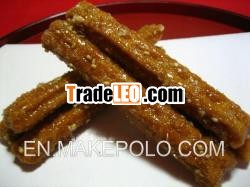
Traditional Japanese snack.Flour is fried in oil and sugar is sprinkled.
It suits tea or coffee well.
Taste of Japan.
TOKIWADO ProducingBanshu-style confections
"KARINTO"
Traditional Japanese snack.Sweetand deep-fried.
It is made primarily of flour andbrown sugar.
Banshu-styleconfections
Banshu-style confections developed alongside Himeji Castle andwere
passed down as the embodiment of traditional skill "KARINTO"
European-style sweets are said to have been intoroduced tojapan
by the Portuguese some 400years ago.
Banshu-style confections(karinto) have a simple, almostindescribable
flavor whose dlicious sensations bring to mind nostalgicmemories of
the past.
Although karinto are typically made by sprinkling a generousecoating
of raw sugar on a lightly fried piece of dough, Banshu-styleconfections
(also known as karinto) consist of a dense, slowly fried pieceof dough
made from cake flour sprinkled with a light coating of sugar andmizuame,
a unique Japanese sweetener.
COSCORAN is the forerunner ofkarinto
Karinto, a confection consisting of deep-fried dough, is believeto have
been introduced to Nagasaki by Europeans, after which it spreadthroughout Japan.
As part of a larger effort to spur the development of localindustry, Hiroomi Kawai,
he chief retainer of the Himeji domain at the time, sent workersto Nagasaki to study
the techniques by which the delicacy was produced. Deep-friedconfections derived
from the European sweets gained popularity in Himeji anddeveloped into what we
now know as Banshu-style confections(karinto).
Recentry, an analysis of European cookbooks from the period hasrevealed that Coscoran,
which is recognized as the forerunner of karinto, was producedusing methods that
are essentially the same as the katakone technique, which iswell established in Himeji.
In short, Banshu-style confections(karinto) have preserved the"ancestor" of coscoran
and passed it down almost entirely intact to the modernworld.
At TOKIWADO, each and every employee strives to createdelicious, high-quality
confections that will put smiles on customers'' faces whiletaking pride in the
traditions and confection-related culture that has developedover the long history
of these delicacies.
| Product Name | Weight | Quantity per case | Ingredients, additives | Photo |
| touhenboku goma(Sesame) | 2P*8 | 10 | Wheat Flour, Vegetable Oil, Glucose Syrup, Suger, Sesame,Shortening, Soybean Protein, Salt, Yeast, Leavening Agent | |
| ''tudumidama kinako(Soy) | 100g | 9 | Sugar, Glucose Syrup, Wheat Flour, Vegetable Oil, SoyFlour, Black Soybean, Shortening, Yeast, Leavening Agent | |
| tudumidama mattya(Green Tea) | 100g | 9 | Sugar, Glucose Syrup, Wheat Flour, Vegetable Oil,Powdered Green Tea, Shortening, Yeast, Leavening Agent | |
| hineridama aka | 90g | 9 | ''Wheat Flour, Vegetable Oil, Sugar, Brown Sugar, StarchSyrup, Sesame, Shortening, Egg, Soybean Protain, Salt, Yeast,Leavening Agent | |
| hineridama kuro(Brown Sugar) | 90g | 9 | Wheat Flour, Sugar, Brown Sugar, Starch Syrup, VegetableOil, Sesame, Shortening, Egg, Soybean Protain, Salt, Yeast,Color(caramel), Leavening Agent |
<Hineridama-Fried dough cake, twisted>
This cake is made with the traditional manufacturing method toknead firmly
so it tough and tastes rich and light.
<Tudumidama-Fried dough cake, wrapped by candy>
The outside of this cake is made with traditional pull candy,and various
material such as powder of fried dough cake and beans entersinside.
PACKAGE
touhenboku goma(sesame) 2Px8
including 10 per case
tuzumidama 100g
hineridama 90g
including 9 per case
web site (japanese only)
http://www.tokiwa-do.co.jp/

