

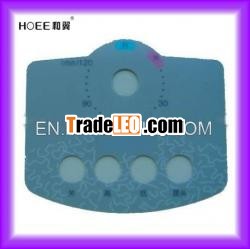
Description:
1.Membrane faceplate2.3M adhesive
3.100% QC
4.UV resistance/Waterproof
Beyond 15 years procution experience
Membrane faceplate
Overlay Materials: The most commonly used basematerials are polyester and polycarbonate.
Rear Adhesive: 3M 467MP, 3M 468MP, etc.
Standard Tolerances: /-.010 inch.
Matching color: Pantone and RAL color matchingsystem.
Environmental
- Storage Temperature: -40°C (-40°F) to 70°C (158°F).
- Storage Altitude: Sea level to 35, 000 feet.
- Operating Temperature and Altitude: -30°C (-30°F) to 75°C(170°F). Can be designed to operate in most environments.
- Humidity: No delamination after 24 hours at 80°C and90%RH.
Membrane faceplate MaterialSelection
The two most widely usedgraphic materials are polycarbonate and polyester. polycarbonatecomes in thicknesses of 0.127 – 0.762mm thick while polyester comesin thicknesses of 0.127 – 0.254mm.
Polyester has greatertensile strength than does polycarbonate, which often allows it towithstand millions of actuations before fracturing. Also, polyesterhas a greater resistance to a broad range of chemicals.
Polycarbonate is slightlyeasier to both print and emboss.
Graphic Design and Preparation
Blueprints – Provide drawings thatclearly dimension all physical characteristics including colorbreaks and copy.
Colors – Identify colors by usingPantone (PMS) color number or a color sample. It is important tosupply the exact standard for which our color match will beevaluated.
Background – Dark backgrounds andlight text will provide greater clarity and show less wear anddirt.
Artwork – It is possible forcustomers to supply useable artwork.
Borders and Outlines – Avoidoutlines close to cutouts or outer edges.
Text – Block lettering providesthe most legible copy. Try to use common fonts. When logos orsymbols are used, it is best to supply film positives or accurateblack and white artwork .
Products show:

