

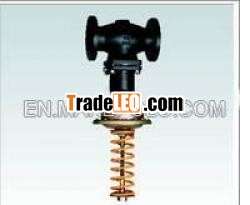
Brand:REOWO
MOQ:1
Rated flow coefficient, noise measuring coefficient,allowable differential pressure
DN | 15 | 20 | 25 | 32 | 40 | 50 | 65 | 80 | 100 | 125 | 150 | 200 | 250 |
Rated flow coefficient | 4 | 6.3 | 8 | 16 | 20 | 32 | 50 | 80 | 125 | 160 | 280 | 320 | 450 |
Noise measuring coefficient Z value | 0.60 | 0.60 | 0.60 | 0.55 | 0.55 | 0.50 | 0.50 | 0.45 | 0.40 | 0.35 | 0.30 | 0.20 | 0.20 |
Allowable differential | PN16 | 1.60 | 1.50 | 1.20 | 1.00 | ||||||||
pressure (Mpa) | PN40 | 2.00 | |||||||||||
Working principle
After throttling by the plug and seat, the before-valve pressureP1 of the process medium is changed into the after-valve pressureP2. Through the control pipeline, P2 is input to the lowerdiaphragm chamber of the actuator and acts on the top disc. Theacting force produced balances the reacting force of the spring,determining relative positions of the plug and seat and controllingthe after-valve pressure. When the after-valve pressure P2increases, the acting force of P2 that actson the top disc w illincrease accordingly . At the time, the acting force on the topdisc is higher than the reacting force of the spring to make theplug close towards the seat, until the acting force on the top discbalances the reacting force of the spring. At the time, the flowarea between the plug and seat is reduced, the flow resistancebecomes higher and P2 is reduced to the set value. Likewise, whenthe after-valve pressure P2 decreases, the acting direction isreverse to the above. This is the working principle during thecontrol of after-valve pressure. When it is necessary to change theset value of after-valve pressure P2, please adjust the adjustingnut.

