

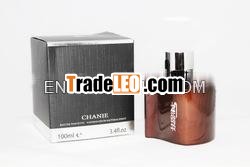
MOQ:5000
Quantity:100
- "base notes" are the fragrance which lingers. It begins toemerge about twenty minutes afterapplication. They are those with thegreatest molecular weight. They last the longest, and are alsoimportant as fixatives, that is, they help slow down theevaporation rates of the lighter notes, giving the fragranceholding power. Common base notes include oakmoss, patchouli, woods,musk and vanilla.
- Here is a quickconversion chart:
100 ml = 3.3 or 3.4 oz
50 ml = 1.7 oz
30 ml = 1 oz
15 ml = 1/2 oz
10 ml = 1/3 oz
7.5 ml = 1/4 oz
5 ml = 1/6 oz
3.7 ml = 1/8 oz = 1 dram
Note that all of these are approximate; strictly speaking, 1/2 ozis 14.787 ml.
A standard perfume sample is in a 1/32 oz (1 ml)vial.
- Apply the perfume to thesepoints: -namely, the inner wrists, the base of the throat,behind ear lobes, in the cleavage, behind knees, and the innerelbows. These spots emanate heat, which can help fragrance to emanate fromyour skin into the air. (It''s the same principle used by essentialoil diffusers). As you wear your perfume throughoutthe day, it will react with your body heat and continue to emitscent.
- EF, EDC, EDT, EDP, SDP, PARFUM, PARFUMOIL -These terms refer to thestrength of the fragrance, or more specifically, to how much highgrade alcohol and/or water has been added to the fragranceoils. Any mixture with a lowerproportion of oil to alcohol is an eau(water).
Eau Fraiche (Usually 3%or less perfume oil)
Eau de Cologne (2 – 5% perfume oil)
Eau de Toilette (4 – 10%perfume oil) - which is offered mostly in ourfactory.
Eau de Parfum (8 – 15% perfumeoil)
Soie de Parfum (15 – 18% perfume oil)
PARFUM or Perfume (15 – 25% also referred toas extract or extrait)
Perfume oil (15-30% perfume oil in an oil rather than alcoholbase)
Difference between Essential oil &Perfume oil
Essential oils arevolatile, fragrant liquids extracted from plant leaves, bark, wood,stems, flowers, seeds, buds, roots, resins and petals, usuallythrough steam distillation. In other words, they are raw materialsthat can be used to create perfumes. They are highly concentratedand apart from a few exceptions, should not be used directly on theskin, although they can be diluted in a carrier oil, such asjojoba, for such use.
Perfume oils arefragrance components, natural or synthetic, in an oily base ratherthan an alcohol base, and can be used directly on theskin.

