

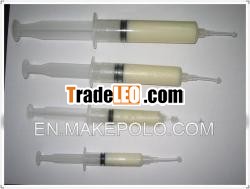
CHEMICAL PRODUCT, COMPANY IDENTIFICATION ANDPACKAGING
Product Name: 2.5%Imidacloprid Gel Bait
COMPOSITIONS AND INFORMATION ON INGREDIENTS
The product is a preparation
Component %(w/w) Imidacloprid 2.5
Glycerol 40
Inert Ingredients 57.5
Packaging Syringe
PHYSICAL AND CHEMICAL PROPERTIES
Physical State: Solid Appearance: yellow or white paste
Odor: Characteristic
pH: ND
Vapor Pressure: NA
Vapor Density: NA
Evaporation Rate: NA
Viscosity: NA
Boiling Point: NA
Freezing/Melting Point: 134.6 – 143.8 °C
Solubility (H2O): Partially soluble
Specific Gravity/Density: 1.54
APPLICATION
Features:It is a professional product for killing cockroaches,can be used both in all public places and home, particularlywherever it is prohibited to apply sprays or powders, and it alsocan be used in any corner, hole or cross where cockroaches arelikely to travel and stay.
Instruction:Place the Gel in place where cockroaches areobserved. Use more Gels where cockroaches are most active.
STABILITY AND REACTIVITY
Stability: Stable
Conditions to Avoid: Extreme temperatures and directsunlight.
Material to Avoid: No available information
Hazardous Decomposition Products: Thermal decomposition mayproduce ammonia, oxides of nitrogen and other small molecularweight hydrocarbons.
TOXICOLOGICAL INFORMATION
Acute Toxicity
Component Analysis - LD50/LC50
Imidacloprid
Rat
LD50 - ROUTE: Inhalation; DOSE: > 5.33 g/m3/4H
LD50 - ROUTE: Oral; DOSE: 410 mg/kg
LD50 - ROUTE: Skin; DOSE: >5000 mg/kg
Mouse
LD50 - ROUTE: Oral; DOSE: 98 mg/kg
Glycerol
Rat LC50 - ROUTE: Inhalation; DOSE: >570 mg/m3/1H
LD50 - ROUTE: Oral; DOSE: 12600 mg/kg
Mouse
LD50 - ROUTE: Intravenous; DOSE: 4250 mg/kg
LD50 - ROUTE: Oral; DOSE: 4090 mg/kg
LD50 - ROUTE: Subcutaneous; DOSE: 91 mg/kg
Rabbit
LD50 - ROUTE: Intravenous; DOSE: 53 gm/kg
LD50 - ROUTE: Oral; DOSE: 27 gm/kg
LD50 - ROUTE: Skin; DOSE: >10 gm/kg
Guinea Pig
LD50 - ROUTE: Oral; DOSE: 7750 mg/kg
Sensitivity: No available Information.
Carcinogenicity: None of this product''s components is listed byIARC, German DFG or United Kingdom, and no evidence of cancereffects caused by Imidacloprid was reported in long-term animalstudies.
Teratogenicity: In rat and rabbit studies, Imidacloprid was notshown to be embryotoxic and teratogenic.
Mutagenicity: A full complement of in vitro and in vivo testsshowed that Imidacloprid was not shown to be mutagenic.
Neurotoxicity: Neonicotinoid insecticides are of relatively lowtoxicity to humans because they react less with human nicotinicreceptor subtypes compared to insects, and they do not readilypenetrate the human blood brain barrier. With poor penetrationthrough the blood brain barrier, centrally mediated effects wouldnot be expected at low levels of exposure. There has been little inthe way of acute overdose or adverse effects reported after humanexposure despite wide usage. Animal studies have confirmed therelatively low toxicity in vertebrate animals compared to insects.In animal studies, moderate to high doses have resulted in CNSstimulation, similar to nicotine, including tremors, impairedpupillary function, and hypothermia. These insecticides are ofmoderate order of toxicity following ingestion, but appear to beless toxic when absorbed dermally or inhaled. Human toxicity datais minimal. In animal studies, evidence of nicotinic stimulation(tremors) has been reported at near-lethal or lethal doses.Following an intentional ingestion of about 9 grams Imidacloprid(an insecticide formulation), mild CNS depression was noted. Adeath was reported in a 69-year-old woman who ingested 200 ml ofImidacloprid 9.6% (19.2 g) in N-methyl pyrrolide.
ECOLOGICAL INFORMATION
Ecotoxicity
Component Analysis - Ecotoxicity - Aquatic Toxicity
Imidacloprid
Test & Species
96 Hr LC50 Rainbow trout 211mg/L
96 Hr LC50 Otherfish 237 mg/L
Glycerol
Test & Species
96 Hr LC50 Rainbow trout 51000 - 57000 mg/L
24 Hr EC50 Daphnia magna > 500mg/L
Environmental Fate: Imidacloprid and its main metabolite,6-chloronicotinic acid, are polar compounds with high solubility inwater. Imidacloprid is stable in acidic and neutral water, butreadily hydrolyzed in alkaline water. Imidacloprid has high watersolubility (510 mg/L) and very low vapor pressure (1.9 x 10(-9)mmHg), making it unlikely to evaporate from soil and plantsurfaces.
Other Adverse Effects: The product may be toxic to bees andaquatic organisms. Do not apply directly to water, to areas wheresurface water is present.
WARNING
Keep it dry and avoid sunshine. Keep it in the places out ofchildren stouch. If it touches skin, please wash at once. If it iseaten by accident, suit the remedy to the case. It belongs tonitryl methylene.

