

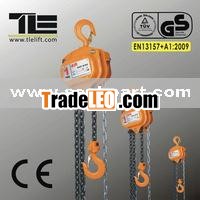
Model:TL0102
Chain Blocks are commonly known as chain blocks and are designed for heavy duty lifting and materials handling operations.
Chain blocks raise and lower loads by pulling on the hand chain. Chain blocks can be of single or double fall configurations depending on the capacity of the block.
1. TECHNICAL DETAILS
* Capacity from 0.25T to 30T.
* Asbestos free brake, holding load at any desired height.
* Robust all-steel construction.
* Top and bottom hooks are fitted with safety latches as standard.
* All rotating components mounted on roller or ball bearings to reduce friction & increase efficiency.
* The hoist is fitted with high grade alloy load chain & Overload Protection Devices are available upon request.
* Optional trolleys: Plain Trolley & Geared Trolley.
* Compact and lightweight for easy handling.
* light-weight steel body with durable powder coat.
* High tensile Grade 80 alloy steel load chain for safety and reliability.
* Drop forged hooks and hook holders to ensure superior quality and safety.
* CE&GS certified.
2. SIMILAR MODELS
3. PRODUCTION
4. INSPECTION BEFORE USE
Ensure that the chain block name plate and WLL is clearly visible and legible.
The pre-use inspection for a chain block should include the following:
* Load chain
Inspect chain for wear.
Inspect chain for gouges, nicks, arc burns, twisted & bent links and corrosion.
Inspect for correct reeving on multi-reeved units (3 and 5 tonne).
Lift wheels & Sheave wheels
Inspect lift wheel for foreign material, wear and corrosion.
Inspect dead end pins for wear, tightness and corrosion.
* Hooks
Inspect hooks for signs of opening, cracking, bending, arc burns and corrosion.
Hooks should swivel freely.
Inspect safety latches for condition & operation.
Measure the hook throats for allowable service openings.
* Hand chain
Inspect chain for wear.
Inspect chain for twisted or gouged links and corrosion.
Inspect connecting link for signs of opening.
* Miscellaneous
Inspect frame and covers for distortion, cracks, gouges, corrosion & other damage.
Inspect hangers (3 and 5 tonne) for cracks, gouges, corrosion & other damage.
Inspect unit for clear WLL identity.
5. CARE IN USE
* The load chain must always mesh correctly with the load sheave. With multi fall chain blocks twists can arise by turning over the bottom hook through the load chain.
* Regularly lubricate the whole length of the load chain with machine or gear oil but be careful not to over lubricate as oil or grease on the brake discs can cause the brake to malfunction and slip.
* Confirm that the brake is functioning properly by hoisting the load 100mm and check the brake when lowering the load.
Non-vertical (sideways pulling) of the hand chain is not recommended on our chain blocks.
* The hand chain is equipped with a safety link. When the safety link opens or deforms, stop at once and inspect for the cause.
Confirm that the monorail beam or structure supporting the chain block is of sufficient strength to support the load to be lifted.
* Never lift loads in excess of the WLL of the chain block.
* Never walk or work under a hoisted load and never lift, support or transport people.
* Use chain blocks manually only.
* Do not permit more than one operator to pull on the hand chain at one time.
* Lift loads correctly with proper slings and attachments. Never lift with the point of the hook and never use the load chain as a sling by back hooking.
* Lifting a load with two chain blocks is not recommended. If the operation is unavoidable, hoist the load with utmost care, keeping the load balanced.
* Never run the load chain out too far. When operated beyond the range of lift, an excessive load that can cause damage will be imposed on the chain block.
* Chain blocks are designed for lifting loads vertically and should not be used for horizontal or angle hoisting.
* Extreme temperatures will reduce the durability of the hoist. Loads should be hoisted or lowered very slowly and carefully in extreme temperatures.
* Never leave a load hanging on the hoist.
* Never use the chain or hook as a ground for welding.
* The hooks and load chains are made of special alloy steels and are precisely heat-treated. Never weld or heat-treat them.
* Load chains are exceptionally long wearing, but wear is unavoidable and certain conditions will cause wear and corrosion that will lower the strength. Load chains worn beyond the permissible limits must be replaced.
* Hooks
The opening will elongate with overloads and incorrect hooking. When the hook opening is elongated beyond permissible limits it is dangerously deformed and must be replaced immediately.
* Never galvanise or subject the chain, or other load bearing parts to any other plating process without the express approval of TLE.

