

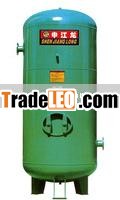
Air Receiver Tank
Specifications:
1.Buffer Compressed Air:Offer additional storage capacity
2.Energy-saving.
3.Maintenance effect.
4.reducing excessive compressor cycling.
5.Eliminate pulsations from the discharge line.
6.Help reduce dew point and temperature spikes that follow regeneration.
Design, manufacture and accept in strict accordance with ISO9001 standard. The material of the adopted steel plate is canonical. The whole body is rolled by numerical control plate bending machine. The full automatic gas shielded welding technique makes the container of standard technology and high quality. Both the inside and outside of the tank are blasted and rust removed by high speed air flow, with best surface quality and serviceability
Specifications:
1. Buffer Compressed Air: especially for the fluctuation air discharge in the air compressors of piston type and with greater air volume flow. Installation of air receiver tank of proper specification with buffering effect will lessen hidden damages to air compressors and downstream gas equipments due to high flow rate compressed air, and reduce rapid pressure fluctuation and stabilize air supply pressure as well;
2. Energy-saving: for some situations where not many air quantities are needed, or areas of product where the air quantities vary in different working period, store enough compressed air through air receiver tank will allow the air compressor stand by for quite a long time, which will bring good energy-saving effect;
3. Maintenance effect: when the air compressor or the after-processing equipments need to be overhauled or maintained after stoppage, the air receiver tank of proper specification will realize no air interruption during stoppage and ensure the maintenance effect of the continuous production
Air receivers are tanks used for compressed air storage and are recommended to be in all compressed air systems. Using air receivers of unsound or questionable construction can be very dangerous. Therefore, the American Society of Mechanical Engineers (ASME) has developed a code regarding the construction of unfired pressure vessels, which has been incorporated into many federal, state, and local laws. This particular code is ASME Code Section VIII Division 1. Air receivers should always meet or exceed this code in addition to any other state, municipal, or insurance codes that may apply.
The ASME also approves the receiver accessories. They are equipped with a safety valve, which is set at a pressure lower than the working pressure for which the air receiver was stamped and at a higher pressure than the operating pressure, to safeguard against excessive pressure. In addition, receivers have a drain valve to eliminate accumulated moisture. They also have pressure gauges, hand-holes or manholes, and a base for vertical air receivers. Standard receivers are designed for horizontal or vertical mounting.
Air receivers serve several important purposes:
• Decrease wear and tear on the compression module, capacity control system and motor by reducing excessive compressor cycling.
• Eliminate pulsations from the discharge line.
• Separate some of the moisture, oil and solid particles that might be present from the air as it comes from the compressor or that may be carried over from the after-cooler.
• Help reduce dew point and temperature spikes that follow regeneration.
• Offer additional storage capacity made to compensate for surges in compressed air usage.
• Contribute to reduced energy costs by minimizing electric demand charges associated with excessive starting of the compressor motor.
The benefit of extra storage capacity alone outweighs the additional cost of this component.


